At dusk they returned home
their soaky clothes torn
and approached the stove
their limbs marked by scratches
their legs full of wounds
but on their brows
there was not a sign of hardship
The whole day just passed
they had to brave the fierceness
of the gold sun
in their paddy field all the time
between the yellowish paddy
and the tall, thorny grasses
desperately reaping the riped paddy
They were born admist hardship
and grew up without a sigh or a complaint
now they are gathering together
making jokes while enjoying their meals
Saturday, 5 May 2012
Gender and Food Security
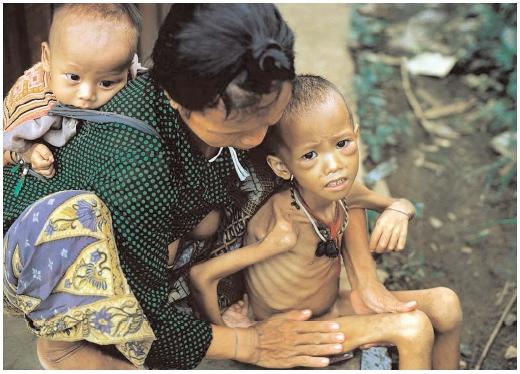
Children and Food Security
On April 29, 2008, a UNICEF UK report found that the world’s poorest and most vulnerable children are being hit the hardest by the impact of climate change. The report, "Our Climate, Our Children, Our Responsibility: The Implications of Climate Change for the World’s Children", says access to clean water and food supplies will become more difficult, particularly in Africa and Asia.[61]
By way of comparison, in one of the largest food producing countries in the world, the United States, approximately one out of six people are "food insecure", including 17 million children, according to the U.S. Department of Agriculture.[62]
A 2012 study in the Journal of Applied Research on Children found that rates of food security varied significantly by race, class and education. In both kindergarten and third grade, 8% of the children were classified as food insecure, but only 5% of white children were food insecure, while 12% and 15% of black and Hispanic children were food insecure, respectively. In third grade, 13% of black and 11% of Hispanic children are food insecure compared to 5% of white children.
Food Security
Food security refers to the availability of food and one's access to it. A household is considered food-secure when its occupants do not live in hunger or fear of starvation. According to the World Resources Institute, global per capita food production has been increasing substantially for the past several decades. In 2006, MSNBC reported that globally, the number of people who are overweight has surpassed the number who are undernourished – the world had more than one billion people who were overweight, and an estimated 800 million who were undernourished. According to a 2004 article from the BBC, China, the world's most populous country, is suffering from an obesity epidemic. In India, the second-most populous country in the world, 30 million people have been added to the ranks of the hungry since the mid-1990s and 46% of children are underweight.
Worldwide around 925 million people are chronically hungry due to extreme poverty, while up to 2 billion people lack food security intermittently due to varying degrees of poverty (source: FAO, 2010). Six million children die of hunger every year – 17,000 every day. As of late 2007, export restrictions and panic buying, US Dollar Depreciation, increased farming for use in biofuels, world oil prices at more than $100 a barrel, global population growth, climate change, loss of agricultural land to residential and industrial development, and growing consumer demand in China and India are claimed to have pushed up the price of grain. However, the role of some of these factors is under debate. Some argue the role of biofuel has been overplayed as grain prices have come down to the levels of 2006. Nonetheless, food riots have recently taken place in many countries across the world.
The ongoing global credit crisis has affected farm credits, despite a boom in commodity prices. Food security is a complex topic, standing at the intersection of many disciplines.
Friday, 4 May 2012
Subscribe to:
Comments (Atom)